top of page
Endcap Logo Color_edited.png
  • Facebook

Art That Doesn’t Ask Permission


What Salvador Dalí Taught Me About Art, Darkness, and the Self


By Chelsea Holley

There are so many artists who have influenced me over the years that it almost feels unfair to choose just one. I love Henri Matisse for his line work and bold simplification. I love Vincent van Gogh for his movement, emotion, and honestly for the tragedy of not being fully appreciated in his own lifetime. But the artist I keep circling back to, the one who fascinated me deeply when I was younger, is Salvador Dalí.


Salvador Dalí at his home in Cadaqués, Costa Brava, Spain, January 8, 1955. Photo via Getty Images.

I studied him while attending Kendall College of Art and Design and even did part of a thesis project on him. Dalí had such an unusual beginning as a person and an artist, but he also had an incredibly classical education. That combination is part of what made him so powerful. His technical skill was undeniable. His shading, perspective, lighting, and rendering abilities were absolutely masterful. And I think that’s important because once an artist truly understands the rules, they can begin bending them in meaningful ways.
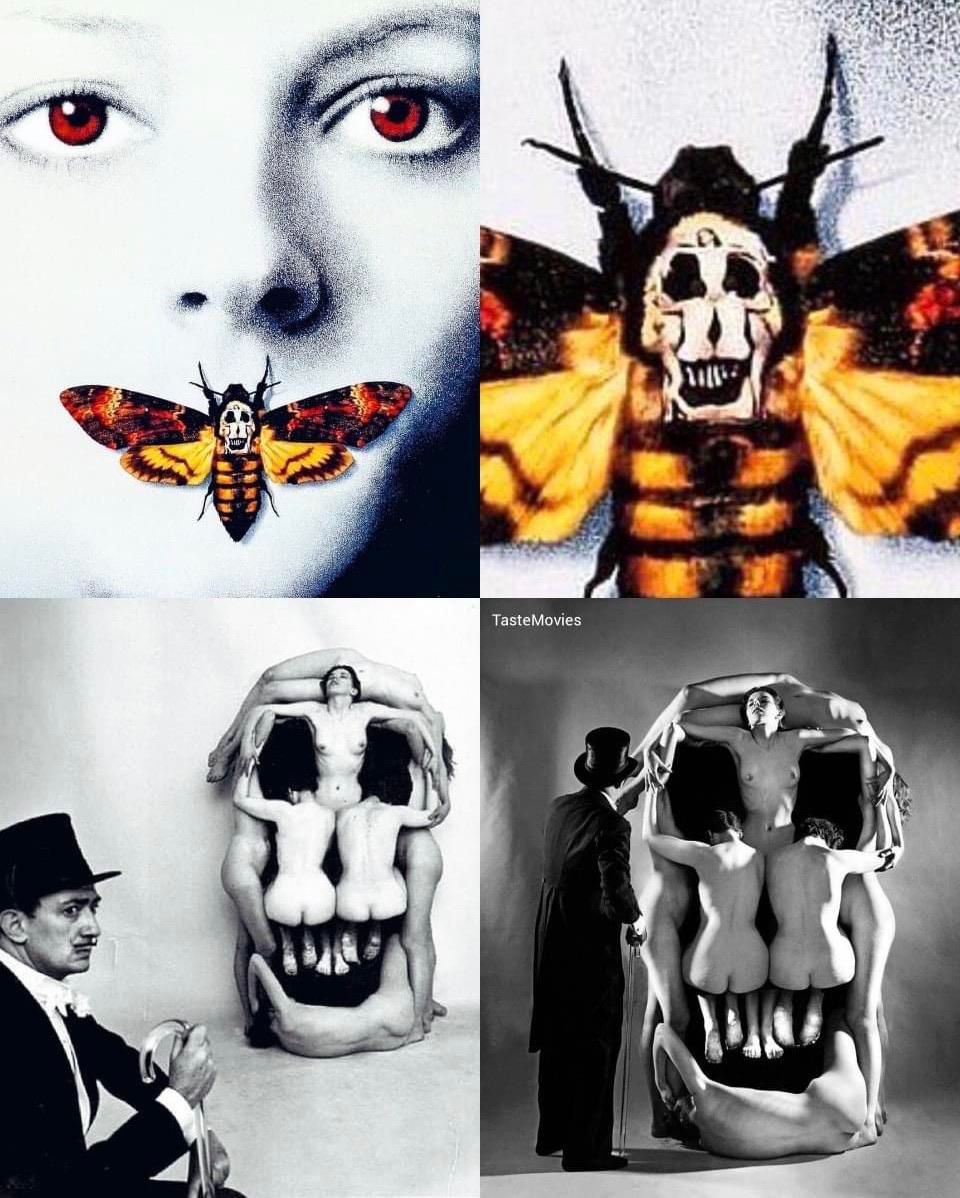

Top left: Promotional poster imagery from The Silence of the Lambs, Orion Pictures, 1991. Top right: Detail of the death’s-head hawkmoth motif used in The Silence of the Lambs poster.Bottom images: Philippe Halsman and Salvador Dalí, In Voluptas Mors, 1951.

You see that with a lot of great artists. Pablo Picasso could paint beautiful realism before moving into abstraction and cubism. Dalí also had that classical foundation, but instead of abandoning technical skill, he used it to drag viewers into surrealism. He painted impossible things with such precision that your brain almost accepts them as real.


© Salvador Dalí, Fundació Gala-Salvador Dalí, Figueres, 2004. Photo © Hans Kaczmarek USA / © Salvador Dalí Museum Inc., St. Petersburg, FL, 2004.

And honestly, I was drawn to the darkness of his work.


The melting clocks. The strange stretched bodies. The horse collapsing into decay. The creepy spidery legs carrying impossible forms. The moths, skulls, death imagery, and dream logic. There was something unsettling but deeply human about it. Dalí’s work felt like defiance wrapped in technical perfection. It lived just inside the acceptable boundaries of madness.


Salvador Dalí, The Disintegration of the Persistence of Memory, 1952 to 1954. Oil on canvas. Collection of The Dalí Museum, St. Petersburg, Florida.

I think a lot of us have broken bits inside ourselves. I certainly do. When I was younger especially, I found his work incredibly relatable because it gave shape to darker emotions and strange inner landscapes that are hard to explain out loud. His art didn’t ask permission to be uncomfortable.


Salvador Dalí, surrealist illustration, c. 1929. Often associated online with Un Chien Andalou/Un perro andaluz.

One thing I’ve always found fascinating (and  maybe troubling ?) was the way Dalí portrayed women. This is just my interpretation, and I know others may disagree, but when I studied his sketches and early drawings at Kendall’s library, I noticed something that stayed with me. His women often felt angular, sharp, aggressive, or emotionally distant. Artists who genuinely adore women tend to soften them in subtle ways even outside realism studies - rounded lines, warmth, sensuality, admiration. Dalí’s women often felt more like symbols, puzzles, or objects of fascination than people being cherished.


Salvador Dalí, Coccyx Women/Les Femmes coccyx, 1938. This is the Dalí that stayed with me: angular bodies, strange extensions, and women turned into something almost architectural or insect-like. It is beautiful in its control, but uncomfortable in what it suggests about the way he saw the body.

And maybe that says something about him.


Salvador Dalí, untitled or unidentified surrealist print featuring the elephant and obelisk motif. This is the kind of Dalí image that feels delicate and disturbing at the same time. The elephant is impossibly thin but still carries something monumental, while the woman’s body feels fragmented, symbolic, and emotionally distant. It is beautiful, but it does not let you relax inside the beauty.

You can feel obsession in his work, but obsession is not necessarily love. I know he had a wife and muse, and clearly women inspired him artistically, but inspiration and emotional intimacy are not always the same thing. When you look at some of his imagery stacking women into skull formations, placing them nude in strange vulnerable situations beside lobsters or symbols of decay  it pushes at the boundaries of what’s acceptable in art, but it also reveals something personal about the artist himself.


Salvador Dalí, Advice from a Caterpillar, from Alice’s Adventures in Wonderland, 1969. Heliogravure with woodcut remarque, published by Maecenas Press-Random House, New York.

That’s part of why his work still captivates me.


Salvador Dalí, The Temptation of Saint Anthony, 1946. Oil on canvas. Royal Museums of Fine Arts of Belgium, Brussels.

Even when Dalí painted religious subjects, he still painted them through the lens of his own obsession and surrealism. His crucifixion paintings are stunning examples of perspective, anatomy, and composition, but even then he couldn’t help making them unmistakably his. He inserted his muse, his symbolism, his strangeness, and his ego into sacred imagery. It’s almost like he was saying: “I will paint holiness, but I will define it on my own terms.”


Salvador Dalí, Crucifixion (Corpus Hypercubus), originally painted in 1954. Even when Dalí approached religious imagery, he could not paint it plainly. In Crucifixion (Corpus Hypercubus), Christ floats against an impossible geometric cross while Gala looks upward from below, turning holiness into something technical, strange, theatrical, and completely his own.

I don’t know that I would call Salvador Dalí my favorite artist. But he is an artist I continually learn from. Every time I revisit his work, I notice something new technically, emotionally, or psychologically. And when I was younger especially, his work made me feel seen in a strange way. It spoke to my darker sides, my angular edges, my broken bits, and the parts of me that didn’t always fit neatly into the world.


Salvador Dalí, Femmes aux papillons, 1953. Gouache, watercolor, printed paper collage, and pen and ink on board, 30 × 40 in. Formerly in the collection of Eleanor Lambert. Christie’s notes that the work was likely connected to Dalí’s fashion-world projects and the International Silk Convention.

And maybe that’s what powerful art does. It doesn’t just show us beauty.


Sometimes it shows us ourselves.


Comments


bottom of page